
NFL Quarter Winner Betting Rules: Highest-Scoring Periods
 Available in US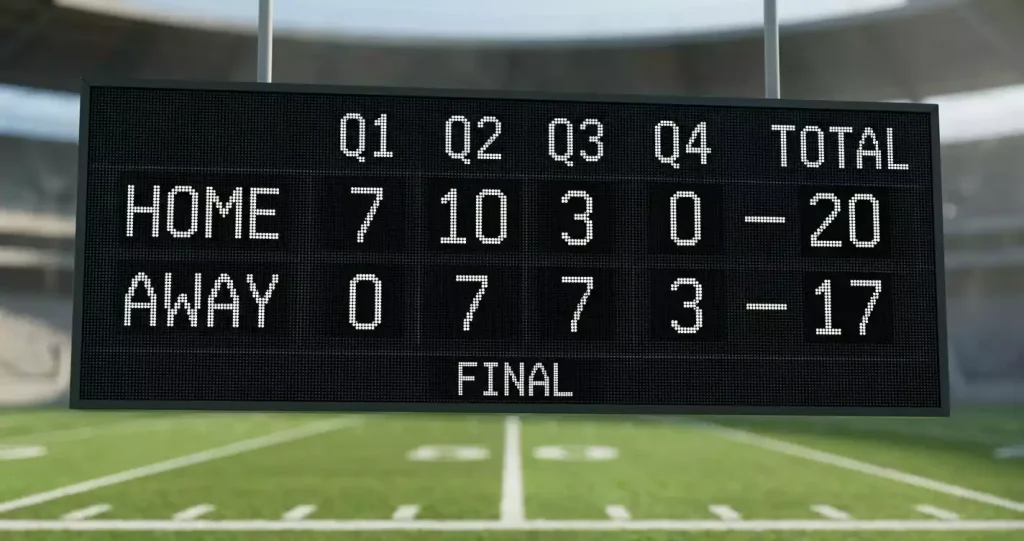
Handling Ties and Overtime in Quarter Markets
The highest-scoring quarter market is one of the prop categories I keep coming back to, because the operator’s prices on this market are often less efficient than on the headline spread and total markets. The first time I genuinely profited from this market was 2019, when I had identified a trend where certain teams produced disproportionate third-quarter scoring after halftime adjustments. The operator priced the third quarter at 11/4 against a fair value closer to 9/4. The bet hit. I have been tracking quarter-level scoring patterns ever since.
Quarter winner and highest-scoring quarter markets sit in the secondary tier of NFL prop markets – well below spreads and totals in volume, but well above the exotic single-event props in punter attention. The growth of the UK NFL betting market has made these secondary markets more relevant. Entain reported 65% growth in UK and Irish NFL punter numbers across 2024, with stakes climbing 46% on the year, and the secondary prop markets have been a steady contributor to that lift as punters look for non-headline ways to engage with the game.
What the highest-scoring quarter market actually asks
The market presents four selections: Q1, Q2, Q3 and Q4 (excluding overtime in most operator implementations). The punter picks which quarter will produce the highest total combined points across both teams. The market settles at the end of the game, with the winning selection determined by comparing the four quarters’ combined scores.
The settlement is straightforward in most cases. The quarter with the highest combined points wins, regardless of which team did most of the scoring within that quarter. A Q3 with 21 combined points beats a Q1 with 14 combined points, even if all 21 points in Q3 were scored by the losing team and all 14 points in Q1 were scored by the eventual winners.
The complication arises when two or more quarters tie for the highest combined score. The standard UK rule is to apply the dead heat formula: divide the stake by the number of tied quarters, settle each tied quarter at the original odds, lose the remainder of the stake. A bet on Q3 at 5/2 with a two-way tie between Q3 and Q4 settles at half the stake against 5/2 odds, giving a half-stake profit calculation.
The pricing logic and the structural lean towards the second half
The pricing on highest-scoring quarter markets typically favours the second half over the first half. Q3 and Q4 are usually priced shorter than Q1 and Q2 because more scoring happens after halftime in the typical NFL game. The pattern reflects coaching tendencies – halftime adjustments tend to open up offences, and trailing teams in the fourth quarter open up their playbooks to chase the game.
A typical price ladder might look like: Q1 at 9/2, Q2 at 11/4, Q3 at 7/2, Q4 at 9/4. The Q4 is often the shortest because late-game scoring is the most predictable feature of NFL games – teams trailing in the fourth quarter score more aggressively than in any other quarter, and the leading team is forced to keep pace to avoid blowing the lead. The Q1 is the longest because opening scripts often produce conservative play-calling and the first quarter tends to be the lowest-scoring on average.
The operator’s margin is built into the prices but the structural information is genuine. A punter who consistently backs Q1 or Q2 on every game will lose money over the long run not just because of the operator’s margin but because the pattern of NFL scoring genuinely leans late. The value bets on highest-scoring quarter markets usually involve specific matchups where the public pricing has not fully accounted for a team’s historical first-quarter dominance or a coach’s known halftime adjustment style.
Quarter winner markets versus highest-scoring quarter
The quarter winner market is a different bet construction. It asks which team will win a specific quarter – Team A wins Q1, Team B wins Q1, tie in Q1 – as a binary or three-way market for each individual quarter. The settlement happens at the quarter-end whistle, with the team scoring more points in that quarter recorded as the winner.
The quarter winner market settles independently for each quarter. A bet on Team A to win Q1 settles at the end of Q1 regardless of what happens in the rest of the game. The settlement is automatic and clears within minutes of the quarter-end whistle, with the operator’s settlement engine reading the official scoring data and clearing all open quarter-winner tickets.
The interaction between quarter winner markets and partial-game markets is worth noting. A Q1 winner bet and a first-half spread bet are not the same bet construction – the Q1 winner asks only about Q1 scoring, while the first-half spread covers Q1 and Q2 combined. The settlement is independent for each market type, and the same game can produce different outcomes on each. The full breakdown of how partial-game markets (first half, second half, individual quarters) settle is in the NFL first half and quarter betting rules article.
How dead heats and tied quarters affect settlement
Tied quarters are surprisingly common because each quarter is only 15 minutes long and many quarters produce no scoring or symmetrical scoring. A quarter where neither team scores produces a 0-0 result, which is a tie for quarter winner purposes. The standard UK rule for a tied quarter on a binary (Team A vs Team B) market is to void the bet and refund the stake.
Three-way quarter winner markets price the tie as a selection. If the punter backed the tie at long odds and the quarter ended scoreless or symmetrically tied, the tie selection pays out. The three-way market is usually offered alongside the binary market, with the tie option available for punters who want longer odds at the cost of accepting the tie risk.
On the highest-scoring quarter market, the dead heat rule applies if two or more quarters tie for the highest combined score. A game where Q2 and Q4 both produce 17 combined points settles the highest-scoring quarter market with a two-way dead heat between Q2 and Q4. A bet on Q4 at 11/4 with a Q2-Q4 dead heat returns half the stake at 11/4, plus the half-stake portion that lost.
Special handling for tied total quarter markets in UK operator terms
Some UK operators apply a “first to” rule rather than a dead heat for the highest-scoring quarter market in specific edge cases. The first to reach the highest score in the game order – i.e., the earliest quarter to reach the eventual winning total – is sometimes recorded as the winner rather than the latest. This is the operator’s choice and is documented in the specific market terms.
The more common UK rule is the dead heat split, which is the cleaner and fairer interpretation. The dead heat splits the stake across all tied quarters, paying each at the original odds. Some operators explicitly call this out in their NFL specific terms, while others apply the dead heat rule as a default across all of their highest-scoring markets without specific NFL clauses.
The implication for punters is that the highest-scoring quarter market is subject to dead heat risk in a way that the spread and total markets are not. A punter who consistently backs the same quarter across multiple games will, over time, see dead heat reductions on a meaningful share of their winning bets. The dead heat is not a bad outcome – it is still a partial win – but it should be factored into the expected value calculation when assessing the bet.
How operators price the four quarters across different matchups
The pricing across the four quarters changes from game to game based on the specific matchup characteristics. A game involving a slow-starting offence might price Q1 longer than the structural baseline. A game involving a coach known for fourth-quarter game management might price Q4 shorter than usual. The operator’s pricing engine adjusts each quarter’s price based on the specific teams’ tendencies and the broader game context.
Among UK paid-search activity for NFL markets, William Hill commanded 37.83% of click-share in February 2026 and Bet365 16.2%, and both operators publish highest-scoring quarter markets on every NFL game. The pricing across the two operators can diverge meaningfully on the same game, particularly on quarters where the operator has a strong house view on a coach’s tendencies. The disciplined punter shops the price ladder across multiple operators before committing.
The 2025 regular season averaged 18.7 million viewers per game across the panel, up 10% on the prior year. The growth in audience has driven growth in betting volume across all NFL markets, including the highest-scoring quarter market specifically. The pricing efficiency has tightened year on year as more sharp money flows through the market, but there remain pockets of inefficiency for the patient and well-informed punter.
How does the highest-scoring quarter market settle if two quarters produce the same combined points?
The standard UK rule is to apply the dead heat formula: divide the stake by the number of tied quarters, settle each tied quarter at the original odds against the divided stake, and lose the remaining portion of the stake. A bet on Q3 at 7/2 with a two-way tie between Q3 and Q4 returns half the stake at 7/2 odds, producing a partial win rather than a full payout or a full loss.
Are NFL quarter winner bets void if the quarter ends scoreless in UK sportsbooks?
On a binary two-way market, yes, the bet is voided and the stake refunded. A scoreless quarter is a tied outcome that cannot be settled in favour of either team. On a three-way quarter winner market that includes the tie as a priced selection, the tie option pays out and the stake on either team"s winner selection is lost. The three-way market is usually offered alongside the binary version for punters who want to price the tie explicitly.
Articles
Created by the "NFL Betting Rules" editorial team.
